


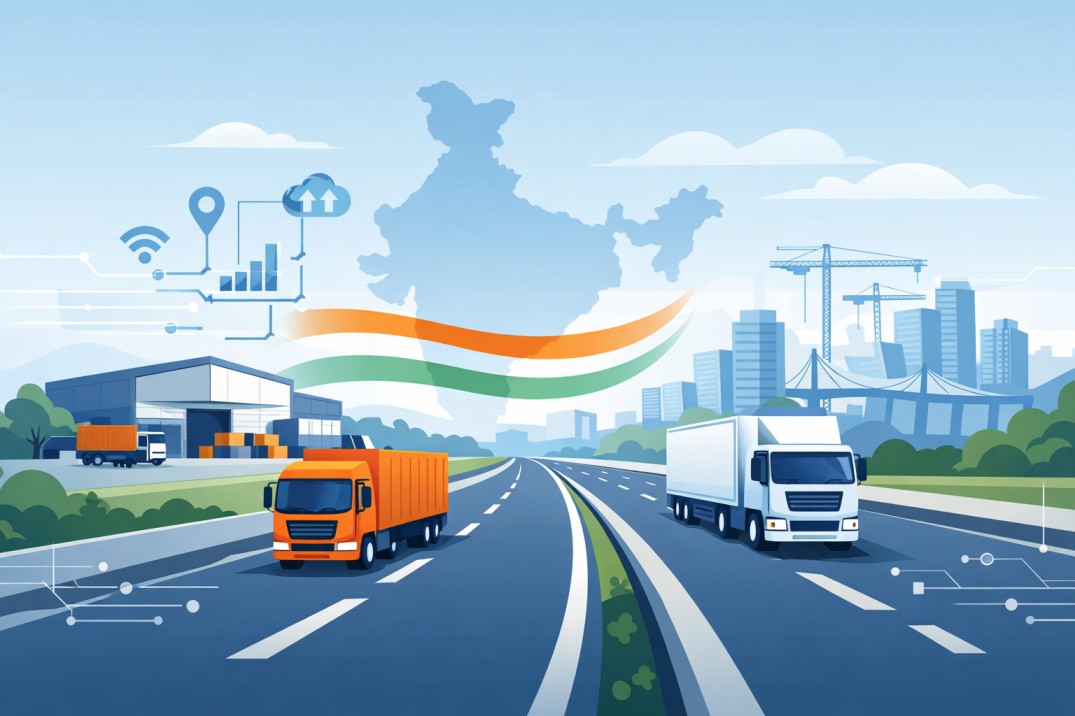
 Union Budget 2026 marks a structural policy shift toward infrastructure-led economic growth. With a record ₹12.2 lakh crore capital expenditure, the budget positions logistics and road transport as core enablers of manufacturing, trade, and regional development.
This whitepaper analyses the budget’s direct and indirect impact on:
-
Fleet owners and truck operators
-
Transport companies and logistics service providers
-
Warehousing and logistics infrastructure developers
-
Digital freight platforms
It also highlights systemic challenges that may influence the pace of growth
Policy Context: Infrastructure as a Growth Engine
The Union Budget 2026 continues the multi-year strategy of increasing public capital expenditure to crowd in private investment and reduce logistics friction.
Key policy signals include:
-
Sustained increase in infrastructure capex
-
Emphasis on highways, freight corridors, and logistics parks
-
Creation of City Economic Regions in Tier-2 and Tier-3 cities
-
Introduction of an Infrastructure Risk Guarantee Fund to de-risk private participation
-
Digital infrastructure incentives supporting cloud and data ecosystems
Budget Reference
-
Union Budget 2026–27, Budget Speech
-
Paragraphs 10–14: Infrastructure-led growth strategy
-
-
Budget at a Glance 2026–27
-
Table 4, Page 4: Capital Expenditure trends
-
Impact on Road Transport and Freight Movement
Macro Impact
The increase in capital expenditure to ₹12.2 lakh crore is expected to improve:
-
Highway density and road quality
-
Freight transit time reliability
-
Connectivity between industrial clusters and consumption centers
-
Integration with rail-based freight corridors
While road transport remains dominant, the budget encourages multimodal logistics, where trucks increasingly handle first-mile and last-mile movement.
Budget Reference
-
Budget at a Glance 2026–27
-
Table 4, Page 4
-
-
Union Budget 2026–27, Budget Speech
-
Paragraph 18: Infrastructure investment as growth multiplier
-
Stakeholder-Wise Impact Analysis
Fleet Owners and Truck Operators
Positive Impact
-
Higher freight availability due to new highways and logistics hubs
-
Improved road quality reducing fuel, tyre, and maintenance losses
-
New regional freight routes emerging around growth hubs
Challenges
-
Partial diversion of long-haul cargo to rail corridors
-
Higher borrowing costs due to elevated government market borrowings
-
Temporary operational disruptions during construction phases
-
Increasing compliance and digitisation requirements
Budget Reference
-
Union Budget 2026–27, Budget Speech
-
Paragraph 22: Freight corridors and multimodal logistics
-
-
Expenditure Profile 2026–27
-
Page 27: Transport sector allocations
-
Transport Companies and Logistics Service Providers
Positive Impact
-
Viability of hub-and-spoke models improves
-
Regional distribution demand rises from Tier-2 and Tier-3 cities
-
Greater predictability in transit timelines
Challenges
-
Increased competition across high-growth corridors
-
Pressure on freight rates due to capacity expansion
-
Dependence on state-level approvals and execution speed
Budget Reference
-
Union Budget 2026 , Budget Speech
-
Paragraph 24: City Economic Regions and logistics hubs
-
-
Budget at a Glance 2026–27
-
Table 7, Page 6: Transfers and support to states
-
Warehousing and Logistics Infrastructure
Positive Impact
-
Rising demand for Grade-A warehouses near highways and corridors
-
Expansion of regional distribution and fulfilment centres
-
Growth in cold chain and cross-dock facilities
Challenges
-
Risk of oversupply in select Tier-2 locations
-
Rising land acquisition and construction costs
-
Higher power and operating expenses
Budget Reference
-
Union Budget 2026–27, Budget Speech
-
Paragraph 26: Logistics parks and urban infrastructure
-
-
Infrastructure Statement 2026–27
-
Page 12: Logistics and warehousing support
-
Digital Freight Platforms
Digital freight platforms benefit indirectly from both physical and digital infrastructure expansion.
Positive Impact
-
Higher transaction volumes as freight activity expands
-
Growth of regional freight markets beyond metro cities
-
Cloud and data-centre incentives supporting scalable logistics technology
In this context, platforms such as Trukky may see increased relevance in regional freight aggregation as infrastructure connectivity improves.
Challenges
-
High cost of onboarding carriers and shippers
-
Margin pressure due to competitive pricing
-
Ongoing compliance with evolving data and tracking regulations
Budget Reference
-
Union Budget 2026–27, Budget Speech
-
Paragraph 62: Tax incentives for data centres and cloud services
-
-
Revenue Proposals 2026–27
-
Page 88: Digital infrastructure and taxation
-
Cross-Cutting Challenges to Growth
Despite strong policy intent, the following factors may moderate growth:
-
Time lag between project announcement and execution
-
Elevated interest rates affecting private investment
-
Uneven regional freight demand
-
Modal shift uncertainty between road and rail
-
Global economic volatility impacting trade volumes
These challenges necessitate phased investment and adaptive business models.
Budget Reference
-
Fiscal Strategy Statement 2026–27
-
Pages 3–4: Borrowing and fiscal consolidation
-
-
Union Budget 2026–27, Budget Speech
-
Paragraph 7: Global economic risks
-
Conclusion
The Union Budget 2026–27 establishes a strong policy foundation for India’s road transport and logistics sector. While benefits will accrue gradually, the long-term direction is clearly positive.
Stakeholders that align early with growth corridors, invest in efficiency, and adapt to multimodal logistics are likely to benefit the most over the next decade.