


Introduction
Broker-Based Truck Booking Risks in India have increased significantly as freight markets become more digitized and fragmented. While transport brokers have traditionally played a connecting role between small fleet owners and transport contractors, the evolving market has created new layers of operational and financial risk. Many Indian businesses still depend on broker-based truck booking for transport service requirements. However, issues around compliance, documentation, SLA enforcement, and fraud exposure have become more visible. In this blog, we decode who brokers are, why broker-based truck booking is risky, and how structured logistics platforms mitigate these challenges.
Who Is a Transport Broker?
A transport broker is traditionally a commission agent who connects fragmented truck owners with transport contractors. Authentic brokers:
-
Aggregate trucks from small fleet owners
-
Manage return-load trucks
-
Earn commission from truck owners
-
Typically work with transport contractors, not directly with shippers
-
Do not issue LR/Bilty or freight invoices
However, a new breed of light brokers has emerged. These brokers:
-
Operate with minimal infrastructure
-
Aggregate trucks from other market brokers
-
Work directly with shippers without compliance structure
-
Operate in grey zones with limited accountability
With low entry barriers due to digitization and marketplaces, such brokers are rising — increasing Broker-Based Truck Booking Risks in India.
Market Reality: Registered vs Unregistered Brokers in India
According to Ministry of Road Transport & Highways (MoRTH) and industry estimates:
-
India has over 1.4 crore registered commercial vehicles
-
However, organized, registered transport brokerage entities are significantly lower
-
Industry bodies estimate that over 60–70% of truck booking intermediaries operate informally or unregistered
This fragmentation increases fraud exposure, tax risks, and operational disputes.
Because many brokers are not registered entities, verification becomes difficult.
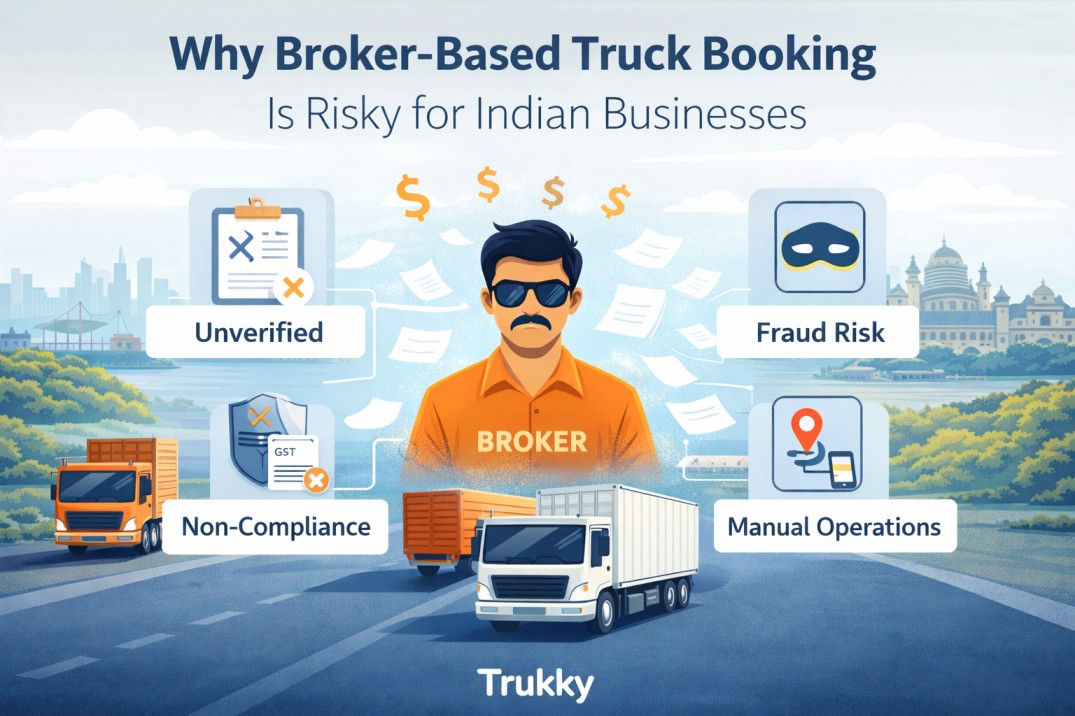
Broker-Based Truck Booking Risks in India
1️⃣ Lack of Registration & Verification
Most brokers operate as informal entities without GST registration or structured documentation.
As a result:
-
Background verification becomes difficult
-
Legal recourse becomes limited
-
Disputes are harder to resolve
2️⃣ Authentication Challenges & Fraud Risk
In broker-based truck booking:
-
There is no standard identity verification system
-
Brokers can change numbers and identities easily
-
Shippers cannot differentiate authentic agents from temporary operators
Therefore, fraud risks increase — especially in high-value shipments.
3️⃣ No Infrastructure to Provide SLAs
Brokers usually operate without:
-
Control towers
-
Monitoring systems
-
Escalation protocols
-
SLA enforcement mechanisms
Consequently, delivery timelines are often based on verbal commitments.
4️⃣ Manual Operations & No In-Transit Support
Most broker-led transport services depend on:
-
Phone calls
-
WhatsApp location sharing
-
Manual follow-ups
There is no real-time shipment visibility, which creates uncertainty and missed appointments.
5️⃣ GST & Documentation Non-Compliance
Since many brokers:
-
Do not issue proper freight invoices
-
Do not generate LR/Bilty
-
Operate without accounting compliance
Shippers may face:
-
GST input credit issues
-
Audit complications
-
Tax reconciliation challenges
6️⃣ Insurance Claim Risks
Operating with unregistered brokers can create insurance claim problems because:
-
Documentation may be incomplete
-
Transport liability is unclear
-
Policy terms may not be fulfilled
In case of cargo damage, claim settlement may get delayed or rejected.
Why Brokers Still Exist in the Value Chain
It must be acknowledged that brokers serve an important role:
-
They help aggregate fragmented supply
-
They support return-load management
-
They connect small fleet owners to demand
However, direct engagement with informal brokers increases exposure to operational and financial risks.
Therefore, it is advisable for businesses to work with registered transport contractors or structured platforms.
How Trukky Reduces Broker-Based Truck Booking Risks in India
Trukky operates as a digital freight platform that brings structure to an otherwise fragmented ecosystem.
Even though brokers are part of the logistics ecosystem, risks are controlled through:
Micro-Broker Aggregation via TAP Network
Trukky’s TAP partner network integrates small brokers into a verified and structured environment.
Broker-Free Logistics Framework
Through operational control and compliance layers, Trukky ensures broker-free logistics for shippers.
System-Based Pricing
Freight rates are discovered through system-based pricing rather than informal negotiation.
Real-Time Shipment Visibility
Shipments are tracked through structured monitoring instead of manual updates.
Compliance-Ready Documentation
LR, invoices, and GST-compliant processes are ensured.
The Safer Alternative for Indian Businesses
As Indian supply chains scale, reliance on informal broker-based truck booking becomes increasingly risky.
Structured transport service models:
-
Reduce fraud exposure
-
Improve SLA adherence
-
Strengthen compliance
-
Enhance shipment predictability
Conclusion
Broker-Based Truck Booking Risks in India are real and growing as freight digitization lowers entry barriers for informal intermediaries. While brokers remain an important link in India’s fragmented logistics network, direct dependency without structured oversight increases compliance, fraud, and insurance risks.
Businesses seeking reliable transport service should prioritize verified networks, system-based pricing, and real-time shipment visibility. Platforms like Trukky combine technology, process, and partner integration to build a safer and more assured freight ecosystem.
In a market where logistics is mission-critical, risk mitigation must become a priority — not an afterthought.