


Introduction
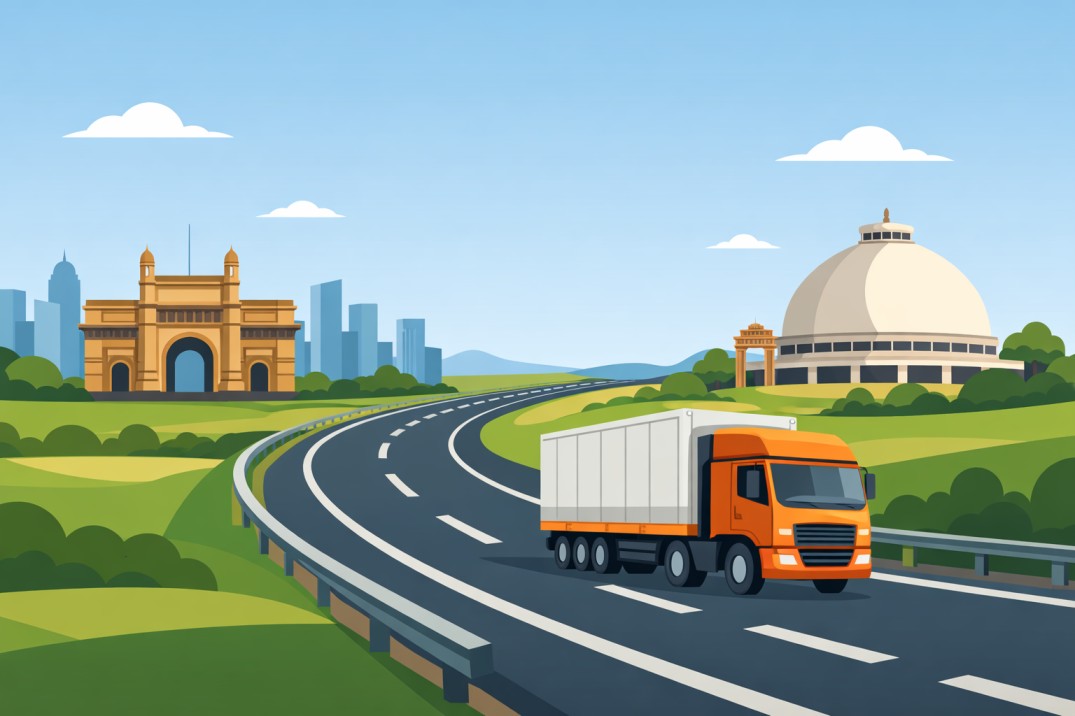
The Mumbai to Nagpur Transport Service plays a crucial role in India’s central freight network, connecting Maharashtra’s commercial capital with the logistics hub of central India. This corridor supports heavy movement of industrial goods, FMCG, agriculture commodities, and manufacturing cargo. Businesses across sectors rely on the Mumbai–Nagpur route for fast and efficient road logistics due to strong highway infrastructure and industrial connectivity. In this route insight, we decode the Mumbai to Nagpur Transport Service in detail, including freight market size, top commodities transported, truck demand, seasonal trends, transit times, and how digital logistics platforms like Trukky simplify truck booking and freight price discovery for businesses.
Market Overview of the Mumbai-Nagpur freight Corridor
The Mumbai to Nagpur Transport Service forms an important industrial corridor connecting western India’s trading ecosystem with central India’s manufacturing and agricultural regions.
Key freight insights include:
-
Estimated annual freight market value: ₹1,000–₹2,000 crore
-
Estimated annual cargo volume: 0.8–1.2 million metric tons
-
Approximate annual truck trips: 60,000–90,000 movements
The corridor connects multiple industrial clusters including:
-
Mumbai / Navi Mumbai / Bhiwandi – logistics and distribution hub
-
Nashik – automotive and engineering cluster
-
Amravati & Nagpur region – agro processing and warehousing hubs
According to the Ministry of Road Transport & Highways and industry logistics estimates, road transport handles nearly 70% of India’s domestic freight, making this route highly dependent on trucking networks.
Top 10 Commodities Transported from Mumbai to Nagpur
Several industries rely on the Mumbai to Nagpur Transport Service to move goods across western and central India.
Major commodities include:
-
FMCG products and packaged food
-
Industrial machinery and equipment
-
Automobile components
-
Chemicals and specialty materials
-
Plastic raw materials and polymers
-
Textile goods and garments
-
Electrical equipment
-
Paper and packaging materials
-
Pharmaceutical products
-
Agricultural commodities and processed food
These shipments originate primarily from Mumbai’s manufacturing and trading ecosystem, while Nagpur acts as a distribution hub for central and eastern India.
Top 3 Trucks in Demand on the Route
Mini Trucks (1–2 Ton)
Mini trucks are widely used for small shipments and SME cargo movement. They are ideal for faster delivery and urban distribution.
Light Trucks (3–7 Ton)
Light commercial vehicles support mid-sized cargo loads such as FMCG and retail shipments. They are commonly booked by traders and distributors.
Medium Trucks (8–15 Ton)
Medium trucks dominate industrial freight movements. They offer optimal load capacity and cost efficiency for long-haul logistics.
Seasonal Freight Trends on the Route
Freight demand on the Mumbai to Nagpur Transport Service fluctuates through the year due to industrial production cycles.
High demand months
-
October to February
-
Festive season cargo movement
-
Agricultural trade shipments
Moderate demand
-
March to June
Low demand
-
July to September (monsoon slowdown)
Freight rates usually increase 5–10% during peak demand periods, especially when truck availability becomes limited.
Return load imbalance is moderate because Nagpur serves as a central redistribution point for goods moving to eastern India.
Mumbai to Nagpur Freight Rate Table
| Truck Type | Freight Rate |
| Load Share | ₹2.5 – ₹4 per kg |
| Mini Truck (1–2 Ton) | ₹15,000 – ₹18,000 |
| Light Truck (3–7 Ton) | ₹20,000 – ₹26,000 |
| Medium Truck (8–15 Ton) | ₹37,000 – ₹50,000 |
| Heavy Truck (Taurus / Trailer) | ₹62,000 – ₹75,000 |
Rates indicative as per Trukky Route Analytics (2025).
Preferred Route & Transit Time
The preferred highway route for the Mumbai to Nagpur Transport Service is:
Mumbai → Nashik → Dhule → Jalgaon → Amravati → Nagpur
Key highway corridors:
-
NH53 (East-West Corridor)
Total Distance: ~830 km
Average Transit Time
-
Full Truck Load (FTL): 24–36 hours
-
Part Load (LTL): 48–72 hours
The route benefits from strong highway infrastructure and industrial connectivity.
How Trukky Simplifies the Mumbai–Nagpur Route
Modern freight movement increasingly relies on digital logistics solutions.
Trukky enables businesses to book trucks faster and more transparently through its digital freight platform.
Key advantages include:
-
Assured services with verified transport partners
-
Inhouse partner network across major freight corridors
-
System-based pricing for instant freight price discovery
-
Broker-free logistics eliminating unnecessary intermediaries
-
Real-time shipment visibility for better planning
By digitizing trucking operations, Trukky improves logistics efficiency and reduces uncertainty in freight pricing.
Conclusion
The Mumbai to Nagpur Transport Service remains one of the most important freight corridors connecting western and central India. With strong industrial connectivity, reliable highway infrastructure, and year-round cargo movement, this route supports manufacturing, trade, and distribution across multiple industries.
Businesses searching for a transport service, Mumbai to Nagpur transport service, transport service in Mumbai, or a transport service near me can now benefit from online truck booking platforms like Trukky that offer transparency, reliability, and technology-driven logistics solutions.
As India’s freight ecosystem continues to digitize, routes like Mumbai–Nagpur will play a crucial role in enabling faster, smarter, and more efficient cargo movement.
FAQs – Mumbai to Nagpur Transport Service
What is the freight rate from Mumbai to Nagpur?
LTL rates range from ₹2.5–₹4 per kg, while FTL rates range between ₹15,000 and ₹75,000, depending on truck type.
How long does transport take from Mumbai to Nagpur?
FTL shipments typically take 24–36 hours, while part-load shipments may take 48–72 hours.
Which trucks are commonly used on this route?
Mini trucks, 3–7 ton trucks, and 8–15 ton trucks are the most frequently used.
What factors influence freight rates?
Rates fluctuate based on fuel prices, seasonal demand, truck availability, and cargo volume.