


Introduction
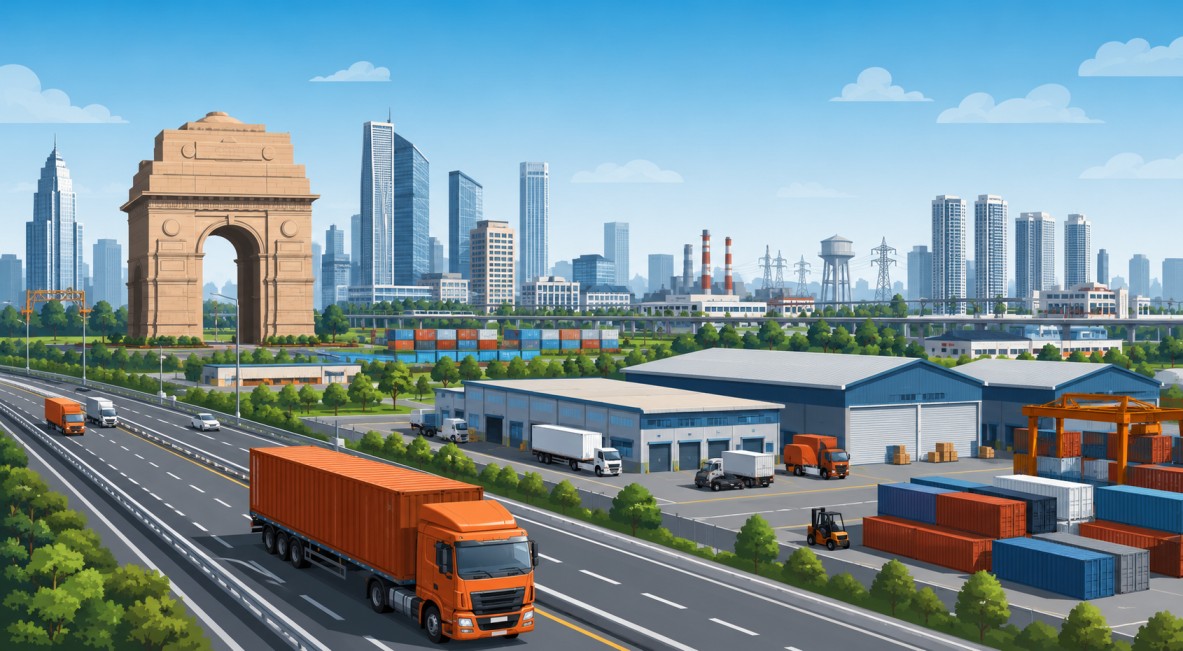
New Delhi is the commercial and administrative heart of North India and one of the country’s largest logistics and freight distribution hubs. Together with the National Capital Region (NCR), comprising Gurugram, Noida, Ghaziabad, and Faridabad, the region handles millions of tonnes of cargo annually, connecting manufacturers, distributors, importers, exporters, retailers, and e-commerce companies with every major market in India. The growing demand for Transport Service in New Delhi is fueled by industrial expansion, warehousing growth, and increasing consumption across North India. This blog explores New Delhi’s logistics market, industrial ecosystem, truck demand, freight movement, and major transport corridors while highlighting how businesses can optimize their supply chains through technology-driven logistics.
Looking for reliable transport solutions in Delhi NCR? Explore Trukky’s Transport Service in Delhi for online truck booking, transparent freight pricing, and nationwide logistics support.
Transport Service in New Delhi: Logistics Market Overview
New Delhi and the NCR together form India’s largest inland logistics ecosystem. The region serves as the primary distribution hub for North India and connects seamlessly with western, central, eastern, and southern markets through an extensive network of expressways, national highways, railway freight corridors, and inland container depots.
Estimated Logistics Market Statistics
| Logistics Indicator | Estimated Value |
|---|---|
| Estimated Logistics Market Size | ₹45,000–₹55,000 Crore annually |
| Annual Freight Movement | 110–130 Million Tons |
| Estimated Daily Truck Movement | 90,000–110,000 Trucks |
| Major National Highways | NH-44, NH-48, NH-9, NH-19 |
| Key Logistics Network | Delhi NCR, DMIC, Eastern & Western Freight Corridors |
The Delhi NCR region benefits from excellent multimodal connectivity through:
- Delhi-Mumbai Expressway
- Delhi-Meerut Expressway
- Eastern Peripheral Expressway
- Western Peripheral Expressway (KMP)
- Dedicated Freight Corridors
- Inland Container Depots (ICDs)
According to industry reports, Ministry of Road Transport & Highways data, and logistics sector studies, Delhi NCR contributes one of the highest shares of organized road freight movement in India.
The region continues to witness rapid investment in warehousing, fulfillment centers, and industrial parks, making Transport Service in New Delhi increasingly important for businesses seeking reliable and scalable logistics services.
Major Industrial Clusters Driving Freight Demand in New Delhi
Unlike many cities, New Delhi’s freight demand extends beyond city limits into the wider NCR. Industrial production, warehousing, and distribution are spread across multiple cities, creating one integrated logistics ecosystem.
Gurugram – Automotive, Electronics & Corporate Logistics
Gurugram has evolved into one of India’s largest commercial and manufacturing centers. The city houses automobile manufacturing, electronics companies, FMCG distribution centers, and thousands of corporate headquarters.
Freight demand is driven by:
- Automobile components
- Consumer electronics
- Retail distribution
- E-commerce fulfillment
- Industrial machinery
Its connectivity through NH-48 makes Gurugram one of the busiest freight destinations in North India.
Noida – Electronics & Manufacturing Hub
Noida has become one of India’s leading electronics manufacturing destinations under the Make in India initiative.
Major industries include:
- Mobile manufacturing
- Consumer electronics
- Electrical equipment
- FMCG
- Packaging
- E-commerce warehouses
The city’s proximity to the Eastern Peripheral Expressway enables efficient interstate cargo movement across northern and eastern India.
Ghaziabad – Engineering & Steel Manufacturing
Ghaziabad is a major industrial city known for:
- Steel products
- Engineering goods
- Construction materials
- Industrial machinery
- Heavy fabrication
Large industrial estates and logistics parks generate substantial truck demand throughout the year.
Faridabad – Manufacturing & Engineering Cluster
Faridabad remains one of Haryana’s oldest industrial hubs with strong presence in:
- Engineering
- Automotive components
- Heavy machinery
- Electrical equipment
- Industrial manufacturing
Its strategic location along NH-19 supports efficient freight movement toward central and eastern India.
Delhi Warehousing & Distribution Network
New Delhi itself is home to numerous logistics parks and wholesale markets including:
- Okhla Industrial Area
- Naraina Industrial Area
- Bawana Industrial Area
- Narela Industrial Area
- Mundka Logistics Cluster
These areas support large-scale freight consolidation and last-mile distribution across North India.
Together, Delhi NCR’s integrated industrial ecosystem generates consistent demand for Transport Service in New Delhi, making it one of India’s busiest freight markets.
Top 10 Commodities Transported from New Delhi
Data Source: Trukky Booking Data 2025–2026
Delhi NCR supports one of India’s most diversified freight portfolios.
| Commodity | Industry Application |
|---|---|
| FMCG Products | Retail and wholesale distribution |
| Consumer Electronics | Manufacturing and nationwide distribution |
| Automobile Components | OEM and aftermarket supply chains |
| Pharmaceuticals | Healthcare and medical distribution |
| Engineering Equipment | Industrial manufacturing |
| Steel & Metal Products | Infrastructure and construction |
| Industrial Machinery | Manufacturing projects |
| E-commerce Shipments | Fulfillment and regional distribution |
| Food & Beverages | Wholesale and retail supply |
| Packaging Materials | Industrial and consumer packaging |
These commodities create year-round demand for Transport Service in New Delhi, particularly for Full Truck Load (FTL), Part Truck Load (PTL), and container transportation.
Top 3 Truck Types in Demand
Data Source: Trukky Booking Data 2025–2026
The diversity of freight moving through Delhi NCR requires multiple truck configurations to support industries ranging from manufacturing to retail.
32 Feet Multi Axle Truck
Capacity: 18–25 Tons
The 32 Feet Multi Axle Truck is the preferred choice for long-distance transportation of heavy industrial cargo, FMCG products, engineering goods, automobile components, and bulk freight.
High demand is observed on routes connecting Delhi with Mumbai, Bengaluru, Chennai, Hyderabad, Ahmedabad, and Kolkata.
20 Feet Container Truck
Capacity: 6–10 Tons
Container trucks are widely used for secure transportation of:
- Export-import cargo
- Consumer electronics
- Pharmaceuticals
- High-value industrial goods
- Retail products
Containerized transport is especially popular among manufacturers located in Noida, Gurugram, and Faridabad.
14 Feet & 17 Feet Trucks
Capacity: 3–7 Tons
These trucks dominate regional freight movement and are commonly used for:
- Intra-state deliveries
- SME logistics
- Distribution to warehouses
- Retail replenishment
- Last-mile industrial cargo
Their flexibility makes them one of the most frequently booked truck categories for online truck booking across Delhi NCR.
Major Transport Routes from New Delhi
The New Delhi freight market serves as the gateway connecting North India with every major industrial and consumption center across the country.
Data Source: Trukky Booking Data 2025–2026
Key National Freight Corridors
Why These Routes Are Critical for Supply Chains
These transport corridors support India’s largest manufacturing and consumption markets by enabling:
- Faster interstate freight movement
- Efficient distribution through national highway networks
- Better truck availability due to consistent cargo volumes
- Reduced transit times through expressway connectivity
- Strong connectivity between manufacturing hubs, ports, warehouses, and retail markets
For businesses seeking reliable Transport Service in New Delhi, these corridors provide the backbone for cost-effective and predictable freight movement across India.
Data Source: Trukky Booking Data 2025–2026
Seasonal Freight Demand Trends in New Delhi
The freight market in New Delhi and the NCR follows predictable seasonal cycles driven by manufacturing output, festive demand, agricultural movement, infrastructure projects, and e-commerce activity. Understanding these patterns helps businesses optimize transportation costs and improve supply chain planning.
High Demand Season (October to March)
Freight demand reaches its peak during the festive season and the final quarter of the financial year.
Key demand drivers include:
- Festive retail inventory movement
- E-commerce sales campaigns
- Automobile production
- Infrastructure and construction projects
- Manufacturing dispatches before financial year closing
Truck availability becomes tighter during this period, especially on long-haul routes from Delhi NCR.
Moderate Demand (April to June)
Industrial production remains stable, although freight movement normalizes after the financial year ends.
This period is ideal for businesses planning long-distance shipments as truck availability generally improves.
Lower Demand Period (July to September)
The monsoon season can affect loading schedules and transit times in several regions.
Although Delhi itself experiences moderate rainfall, shipments moving toward eastern, central, and western India may experience delays due to weather-related disruptions.
Peak Freight Rate Periods
Freight prices generally increase during:
- October to December
- Financial year-end (February–March)
- Major festive seasons
- Agricultural harvest movement
- Long weekends and holiday periods
Return Load Imbalance
Several outbound corridors from Delhi experience return-load imbalances, particularly routes toward northern and eastern India. Empty return trips increase operational costs, which directly impacts freight pricing on certain lanes.
Businesses that plan shipments in advance often benefit from better truck availability and more competitive freight rates.
Freight Rate Insights in New Delhi
New Delhi is one of India’s busiest freight markets, where pricing is influenced by continuous industrial activity, retail demand, and interstate cargo movement.
Average Freight Rates
Intrastate Freight
₹0.6/Kg to ₹0.9/Kg
Interstate Freight
₹1.3/Kg to ₹11/Kg
Freight rates on many Delhi routes remain at a premium due to consistently high shipment volumes and strong truck utilization.
Why Freight Rates Fluctuate
Supply-Demand Imbalance
The NCR generates significant outbound freight every day. During peak business periods, truck demand often exceeds available capacity, leading to higher freight prices.
Industrial Seasonality
Manufacturing output from Gurugram, Noida, Ghaziabad, and Faridabad directly impacts truck demand throughout the year.
Distance-Based Pricing
Long-haul routes generally offer better freight efficiency per kilogram, while shorter routes may have higher operational costs due to loading, unloading, and turnaround times.
Truck Availability
Specialized vehicles such as container trucks, multi-axle trucks, and high-capacity trailers may experience temporary shortages during peak demand periods.
Fuel Prices & Toll Costs
Variations in diesel prices and toll charges also contribute to fluctuations in freight pricing across major corridors.
For businesses, comparing freight quotes, planning dispatch schedules, and booking trucks in advance can significantly reduce logistics costs.
Key Logistics Challenges Faced by Shippers in New Delhi
Despite having one of India’s largest logistics ecosystems, shippers still encounter several operational challenges.
Broker-Driven Logistics Market
Many businesses continue to depend on multiple transport brokers, resulting in inconsistent pricing and limited accountability.
Lack of Pricing Transparency
Freight quotations often vary between transporters, making it difficult for businesses to benchmark logistics costs accurately.
Difficulty Finding Reliable Trucks
During peak seasons, securing verified trucks at competitive rates becomes increasingly challenging.
Limited Shipment Visibility
Traditional transport operations frequently rely on manual communication, making real-time shipment tracking difficult.
Transit Delays
Urban congestion, loading delays, toll queues, and seasonal traffic restrictions can impact delivery timelines and supply chain efficiency.
These challenges increase logistics costs and reduce operational visibility for businesses.
How Trukky is Transforming Transport Service in New Delhi
The logistics industry is rapidly adopting digital technologies to improve efficiency, transparency, and customer experience.
Trukky is helping businesses modernize freight operations through a digital freight platform built for India’s evolving logistics ecosystem.
Technology-Driven Logistics Solutions
System-Based Pricing
Trukky uses system-based pricing to provide transparent and competitive freight quotations based on shipment details, reducing pricing uncertainty.
Broker-Free Logistics
The platform enables broker-free logistics by connecting businesses directly with verified transport partners, improving efficiency while reducing dependency on traditional intermediaries.
Real-Time Shipment Visibility
Businesses receive real-time shipment visibility, enabling better planning, proactive communication, and improved customer satisfaction.
Assured Services
Trukky offers assured services supported by verified transport partners, helping businesses move cargo with greater confidence.
In-House Partner Network
An extensive in-house partner network across India ensures better truck availability, wider route coverage, and reliable freight movement for both local and interstate shipments.
Whether businesses require online truck booking, Full Truck Load (FTL), Part Truck Load (PTL), or enterprise logistics solutions, Trukky provides an efficient platform for managing freight operations across New Delhi and the entire NCR.
Conclusion
Key Takeaways
- New Delhi is India’s largest inland logistics and freight distribution hub.
- The NCR cities of Gurugram, Noida, Ghaziabad, and Faridabad collectively drive one of the country’s highest freight volumes.
- Strong highway connectivity, industrial growth, and expanding warehousing continue to increase truck demand.
- Freight pricing is influenced by industrial production, truck availability, seasonal demand, and route dynamics.
- Digital logistics platforms are improving pricing transparency, shipment visibility, and operational efficiency.
As India’s logistics sector continues its digital transformation, technology-enabled freight platforms will play an increasingly important role in helping businesses optimize transportation costs, improve delivery reliability, and build more resilient supply chains. The future of Transport Service in New Delhi will be defined by data-driven logistics, automation, and intelligent freight management.
Frequently Asked Questions (FAQs)
What is the average transport cost in New Delhi?
Transport costs generally range from ₹0.6/Kg to ₹0.9/Kg for intrastate shipments and ₹1.3/Kg to ₹11/Kg for interstate transportation, depending on truck type, cargo, and route.
Which trucks are most commonly used for transport in New Delhi?
The most commonly used trucks include 32 Feet Multi Axle Trucks, 20 Feet Container Trucks, and 14 Feet & 17 Feet Trucks for industrial, commercial, and retail freight movement.
How can I book trucks online in New Delhi?
Businesses can book trucks through Trukky’s digital freight platform by entering shipment details, selecting the appropriate truck type, receiving an instant freight quotation, and confirming the booking online.
What factors affect freight rates in New Delhi?
Freight rates depend on shipment distance, truck type, cargo weight, seasonal demand, truck availability, fuel prices, toll charges, and market demand-supply conditions.