


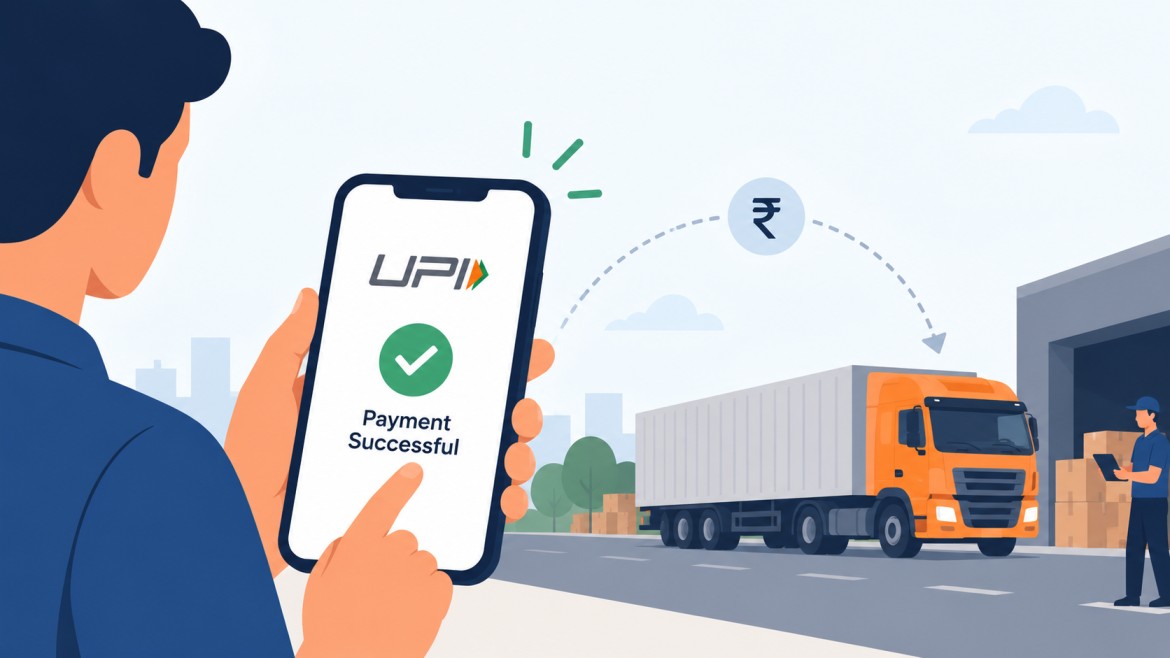
What the new UPI MDR of 0.4% means for India’s spot logistics and FTL freight industry
For years, UPI has been one of the simplest ways to move money in India’s logistics industry.
A transporter can quote a freight rate, collect payment, confirm the booking and move the truck without relying on cash, cheques or lengthy payment coordination.
UPI helped make the payment side of spot logistics digital.
Now, from 15 October 2026, a new UPI Merchant Discount Rate, or MDR, is scheduled to apply to specified Person-to-Merchant (P2M) transactions above ₹2,000.
The standard rate is 0.4%, capped at ₹300 per transaction for transactions of ₹75,000 and above. P2P transactions remain outside the MDR framework, while specified small merchants and certain categories have separate treatment. The MDR is not intended to be directly charged to consumers. Reuters’ report on the new UPI MDR framework
For consumers, 0.4% may sound small.
For a thin-margin logistics business, the number looks very different.
The question is:
Will logistics companies absorb the cost as the price of payment convenience, or will payment costs eventually become part of freight economics?
1. What is changing?
The standard MDR applies to specified merchant transactions above ₹2,000.
| Transaction value | MDR at 0.4% |
|---|---|
| Up to ₹2,000 | ₹0 |
| ₹10,000 | ₹40 |
| ₹25,000 | ₹100 |
| ₹50,000 | ₹200 |
| ₹75,000+ | ₹300 maximum |
The important distinction is P2M versus P2P.
P2M refers to payments to merchants or businesses. P2P refers to person-to-person transfers. The new MDR framework applies to specified P2M transactions, while P2P remains outside it. Indian Express’ explanation of UPI MDR
2. UPI has become part of India’s business infrastructure
The scale of UPI is enormous.
According to NPCI’s official UPI Product Statistics, in August 2026 UPI processed:
| Metric | August 2026 |
|---|---|
| Transactions | 24.51 billion |
| Transaction value | ₹29.82 lakh crore |
| Live banks | 752 |
UPI is no longer simply a consumer payment application.
It is increasingly part of how businesses collect and move money.
Logistics is a good example.
3. UPI changed the payment flow in spot logistics
Traditional spot logistics could involve:
Quote → Truck confirmation → Payment → Loading → LR → Tracking → POD → Settlement
Payment could involve cash, cheques, bank transfers and manual reconciliation.
With digital payments, the process can become:
Quote → Book → Pay → Confirm
That matters in an industry where payment confirmation can influence truck assignment and loading.
UPI can reduce:
- Cash and cheque handling
- Payment confirmation delays
- Manual follow-ups
- Reconciliation effort
- Friction between payment and booking
In simple terms:
UPI didn’t just digitise payments. It helped digitise the payment workflow around the truck.
4. What does a UPI transaction actually cost?
There is no single publicly disclosed figure for NPCI’s exact current cost per UPI transaction.
A UPI payment involves multiple layers of infrastructure.
A working model can look like this:
| Layer | Estimated cost / transaction |
|---|---|
| NPCI infrastructure | ₹0.06–₹0.18 |
| Remitter bank | ₹0.10–₹0.30 |
| Beneficiary / acquiring bank | ₹0.08–₹0.25 |
| UPI app / PSP / TPAP | ₹0.02–₹0.10 |
| Fraud, disputes & reconciliation | ₹0.03–₹0.10 |
| Estimated ecosystem cost | ₹0.29–₹0.93 |
Important: These are illustrative working estimates, not officially disclosed NPCI transaction costs.
Some reporting has cited annual UPI operating-cost estimates of around ₹20,000 crore, although the scope and methodology vary. Financial Express analysis of UPI operating costs
Industry estimates suggest the new MDR framework could create a potential annual revenue pool of around ₹16,000–₹20,000 crore. This is an industry estimate, not an official NPCI projection. Financial Express report on UPI MDR revenue estimates
5. 0.4% looks small. Until you look at logistics margins.
Logistics is a thin-margin business.
For this analysis, let’s use an 8% average margin assumption for spot FTL operations.
Consider a ₹25,000 freight transaction.
₹25,000 × 0.4% = ₹100
At an 8% margin:
₹25,000 × 8% = ₹2,000
So the ₹100 MDR represents 5% of the ₹2,000 margin.
| Freight value | 0.4% MDR | 8% margin | MDR as % of margin |
|---|---|---|---|
| ₹10,000 | ₹40 | ₹800 | 5.0% |
| ₹25,000 | ₹100 | ₹2,000 | 5.0% |
| ₹50,000 | ₹200 | ₹4,000 | 5.0% |
| ₹75,000 | ₹300 | ₹6,000 | 5.0% |
So the headline number is 0.4% of freight value.
The operating reality can be closer to:
0.4% of revenue = 5% of an 8% margin.
For a single shipment, ₹100 may not change the business.
Across thousands of shipments, it can.
The 8% margin is a working assumption for this analysis, not an official industry-wide benchmark.
6. Digital freight platforms have a different equation
The impact is particularly interesting for digital freight platforms.
A platform such as Trukky already collects freight payments digitally, typically through payment gateway links.
Payment gateways themselves already carry MDR or processing costs. Depending on the provider and commercial arrangement, this can be in the 0.2%–0.5% range.
So for a digital freight platform, the question is not simply:
“What will the new 0.4% cost us?”
It is:
“What is the total cost of collecting and reconciling a freight payment?”
Because digital payment provides more than payment acceptance.
It can provide:
Payment → Automatic confirmation → Booking mapping → Settlement data → Reconciliation
Compare that with a bank transfer:
NEFT/IMPS → Bank statement → Identify payer → Match amount → Find booking → Update system → Reconcile
The bank transfer may reduce the visible payment cost.
But it can increase the manual cost of reconciliation.
7. The hidden cost of moving away from digital collection
For a digital freight platform, shifting customers from payment gateway collections to NEFT or IMPS purely to avoid MDR can create another problem.
Someone may have to:
- Check the bank statement
- Identify the payer
- Match the amount
- Locate the booking
- Verify the payment reference
- Update the system
- Reconcile the transaction
- Resolve unmatched payments
At scale, that is a people cost, technology cost and operational cost.
This is why the real calculation should not be:
MDR = payment cost
It should be:
Total payment cost = Payment cost + reconciliation + operational effort + failure/dispute cost
For Trukky and similar digital freight platforms, the existing payment-gateway cost was already being absorbed as part of the cost of digital collection, automation and reconciliation.
The new UPI MDR therefore adds another layer to an already existing payment-cost equation.
8. Absorb it or pass it on?
This is perhaps the most important question for the logistics industry.
There are three broad possibilities.
Absorb
Treat MDR as the cost of convenience and digital operations.
Reflect it in freight economics
Factor payment costs into the overall freight rate and margin calculation.
Optimise the payment mix
Use different payment methods depending on transaction size, cost, settlement, customer preference and reconciliation effort.
There is no single answer for every logistics business.
A transporter with low digital payment volumes may see the cost differently from a digital freight platform processing thousands of transactions every month.
9. The ₹300 cap changes the picture for larger freight
The standard MDR is capped at ₹300 for transactions of ₹75,000 and above. Reuters’ report on the MDR structure
| Freight payment | MDR | Effective MDR |
|---|---|---|
| ₹25,000 | ₹100 | 0.40% |
| ₹50,000 | ₹200 | 0.40% |
| ₹75,000 | ₹300 | 0.40% |
| ₹1,00,000 | ₹300 | 0.30% |
| ₹2,00,000 | ₹300 | 0.15% |
| ₹5,00,000 | ₹300 | 0.06% |
This means the impact is not uniform.
For smaller spot freight transactions, the full 0.4% matters more.
For larger transactions, the cap reduces the effective rate significantly.
10. Why payment orchestration becomes more relevant
The next step may not be simply finding the cheapest payment method.
It may be optimising the entire payment flow.
A digital logistics platform could evaluate:
- Transaction value
- MDR
- Payment success rate
- Settlement time
- Reconciliation effort
- Customer preference
- Risk
- Operational cost
The objective becomes:
Minimise the total cost of moving money, not simply the MDR.
This is where payment orchestration becomes strategically interesting for digital logistics.
11. The bigger picture
UPI helped make freight payments faster and more digital.
The new MDR makes the economics of that convenience more visible.
For a ₹25,000 eligible freight payment:
₹100 MDR
That sounds small.
But at an 8% margin:
₹100 = 5% of the margin
And for a digital freight platform, the alternative may not be “free.”
Moving collections to NEFT or IMPS can introduce manual reconciliation, payment matching and operational follow-up.
So the industry is not simply choosing between:
0.4% vs 0%
It may actually be choosing between:
Digital payment cost vs total cost of an alternative payment process.
That is the more useful way to look at the change.
12. The question for logistics
UPI has already delivered something valuable to logistics:
speed, convenience and a more digital payment workflow.
The new MDR does not change that value.
It changes the economics around it.
For logistics companies and digital freight platforms, the question going forward may therefore be:
Should the cost of digital payment be absorbed, reflected in freight economics, or optimised through a smarter payment mix?
The answer will likely vary by business model.
But one thing is becoming clear:
The cost of moving money is becoming almost as important to digital logistics as the cost of moving the truck.
Frequently Asked Questions
What is UPI MDR?
MDR, or Merchant Discount Rate, is a fee associated with accepting certain merchant payments. Under the announced framework, specified P2M UPI transactions above ₹2,000 will attract a 0.4% MDR from 15 October 2026, subject to applicable rules and caps. Reuters’ UPI MDR report
How much is the UPI MDR on a ₹25,000 freight payment?
At 0.4%, the MDR would be ₹100 on an eligible ₹25,000 P2M transaction.
Does every UPI transaction attract 0.4% MDR?
No. The 0.4% MDR applies to specified P2M transactions above ₹2,000. P2P transactions remain outside the framework, and certain merchant categories have separate provisions. Indian Express’ UPI MDR explanation
Will consumers pay the MDR?
The announced framework is not designed for the MDR to be directly charged to consumers. Reuters’ coverage of the new framework
What is the maximum MDR?
For the standard 0.4% category, the charge is capped at ₹300 per transaction for transactions of ₹75,000 and above. Reuters’ report on the UPI MDR structure
How will UPI MDR affect logistics companies?
The impact will depend on freight value, payment volume, margins and payment mix. For a ₹25,000 eligible transaction, the MDR is ₹100. At an 8% margin assumption, that represents 5% of the transaction margin.
How could UPI MDR affect digital freight platforms?
Digital freight platforms may already pay payment-gateway MDR for online collections. The new UPI MDR adds to that payment-cost equation, while shifting collections to bank transfers could increase manual reconciliation and operational costs.
Should logistics companies absorb or pass on the MDR?
There is no single industry-wide answer. Companies may absorb the cost, reflect it within overall freight economics, negotiate payment costs, or optimise their payment mix.
Why is payment orchestration becoming important?
As payment costs become more visible, businesses can benefit from evaluating payment methods based on total economics rather than MDR alone, including success rate, settlement, reconciliation, customer experience and operational cost.